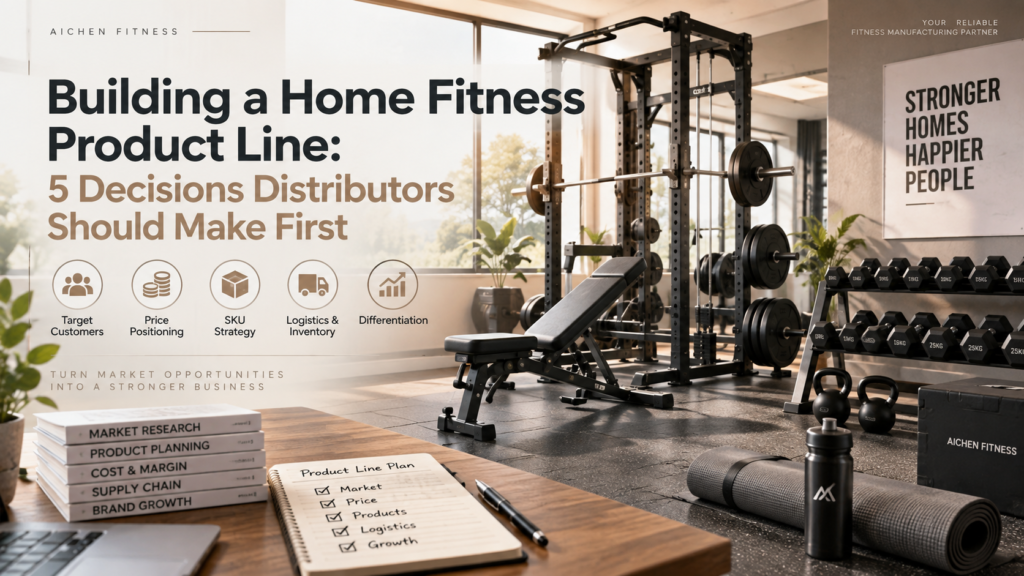
Building a Home Fitness Product Line: 5 Decisions Distributors Should Make First
A strong home fitness product line is not simply a collection of popular equipment.
Each SKU should have a clear role.
For distributors and retailers, the goal is to build a product range that balances customer demand, purchasing cost, margin, logistics and inventory risk.
Before adding more products, make five important decisions.
1. Who Is Your Customer?
“Home fitness customer” is too broad.
Your customers may include:
- Beginners building their first home gym
- Strength-training enthusiasts
- Customers with limited space
- Premium home gym buyers
- Price-sensitive e-commerce customers
These groups expect different products and price points.
Understanding the customer first makes product selection much easier.
2. Define Your Price Architecture
A product line should have clear price positioning.
Instead of choosing products independently, consider how customers move through your range.
You may have:
Entry Level
Simple products designed around affordability.
Core Range
Products offering the best balance between functionality and price.
Premium Range
Higher-specification products with additional features or stronger differentiation.
This helps prevent your own products from competing against each other without a clear reason.
3. Give Every SKU a Role
Not every product needs to be a bestseller.
Some products attract customers.
Some generate margin.
Some increase average order value.
Some complete the product range.
For example, a distributor selling power racks may also carry:
- Adjustable benches
- Weight storage
- Attachments
- Bars
- Accessories
The value of these products is not only their individual sales volume. Together they create a more complete buying solution.
4. Consider Logistics Before Finalizing the Product
Fitness equipment is heavy and often bulky.
A small structural change can significantly affect:
- Carton dimensions
- Container loading
- Warehouse space
- Courier charges
- Fulfillment costs
This means product development and logistics should not be separated.
A product with an attractive factory price may become uncompetitive after transportation and fulfillment costs are included.
For distributors, landed cost matters more than quotation price.
5. Decide Where You Need Differentiation
Not every product requires a completely original structure.
Consider where differentiation produces the greatest commercial value.
Possible areas include:
- Color
- Branding
- Packaging
- Attachments
- Dimensions
- Storage
- Upholstery
- Product bundles
- Functional improvements
The goal is to create enough differentiation for customers to understand why they should choose your product without adding unnecessary manufacturing cost.
Start With a Focused Range
Launching too many SKUs at once increases inventory pressure.
A focused initial range makes it easier to understand:
- Which products generate traffic
- Which products convert
- Which price points perform best
- Which features customers value
- Which SKUs should be reordered
Sales data from the first product range can then guide future development.
Improve the Range With Real Market Data
Product development should continue after launch.
Monitor:
- Sales velocity
- Customer feedback
- Returns
- Competitor pricing
- Inventory turnover
- Repeat-order performance
If one product sells significantly faster than expected, related products or upgraded versions may deserve more investment.
If another product slows after the first shipment, future purchasing should be adjusted rather than automatically repeating the same quantity.
Final Thoughts
Building a successful home fitness product line requires more than finding products with attractive factory prices.
Distributors need to balance:
Demand + differentiation + purchasing cost + landed cost + margin + inventory risk
The strongest product ranges usually evolve gradually using real sales data.
AICHEN works with fitness brands, distributors and retailers to develop and manufacture home fitness equipment around different price points, sales channels and market requirements.
Building your next home fitness product range? Send AICHEN your target products, market and price range to discuss a manufacturing solution.